
Orris: The Ingredient Behind That "Old Money" Elegance in Perfume
|
|
Time to read 4 min

subscribe to news
Stories of scent and craft, dispatched occasionally from our atelier. Fewer emails, more meaning.
|
|
Time to read 4 min
Not loud.
Not trendy.
Not trying to impress you.
Just composed.
There’s a particular quality in certain perfumes — often described as powdery, polished, or quietly expensive — that’s difficult to name but easy to recognize.
That effect is rarely accidental.
And more often than not, it traces back to one material:
Orris.
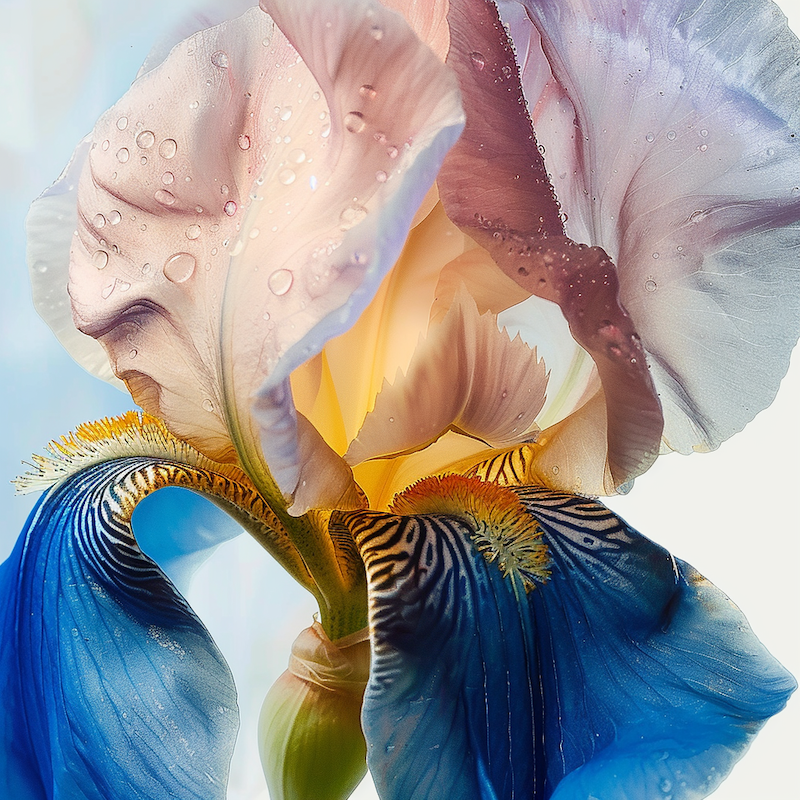
This isn’t an article about loving iris.
It’s about understanding why some fragrances feel timeless while others feel temporary.
Modern fragrance marketing emphasizes:
Top note sparkle
Projection
Immediate impact
But the sensation of refinement usually comes from the middle-to-base architecture.
From materials that don’t shout — but shape.
Orris is one of the most important of those materials.
Orris butter does not come from the iris flower.
It comes from the rhizome — the underground stem.
And it requires extraordinary patience.
Iris plants grow for 3–4 years before harvest.
Rhizomes are then dried and aged for 3–5 additional years.
Only during aging do irones — the key aromatic molecules — fully develop.
Fresh rhizome smells like almost nothing.
Time creates the scent.
Yield is extremely low: roughly 500 kg of dried rhizome produce about 1 kg of orris butter.
This timeline alone explains why genuine orris is one of the most expensive materials in perfumery.
But cost isn’t the point.
Structure is.
Orris has a distinct profile:
Powdery (but not chalky)
Violet-like
Woody beneath the floral surface
Slightly creamy
More importantly, it performs three structural roles:
Some fragrances feel thin.
Others feel like velvet.
Orris contributes density and softness simultaneously, giving the illusion of texture.
Many compositions struggle in the transition from heart to base.
Orris smooths that shift.
It connects rose to sandalwood.
It softens vetiver.
It refines amber.
This bridging quality is why so many classic French perfumes rely on it.
Powdery notes are often misunderstood.
When poorly constructed, they feel dated.
When structured correctly, they read as tailored.
Controlled.
Composed.
Orris doesn’t create hype.
It creates finish.
The primary aroma molecules in orris are irones.
Chemists can synthesize them.
But natural orris contains hundreds of secondary compounds that create micro-variations in diffusion and depth.
Those supporting molecules:
Add dimensional nuance
Soften harsh edges
Increase persistence without aggression
Synthetic isolates often reproduce the headline — but not the undertone.
Which is why fragrances built with genuine orris tend to feel rounder and more integrated.
You don’t need to know the note pyramid.
Look for these signals:
A subtle cosmetic or lipstick-like softness in the heart
A powder effect that feels dry and elegant, not sugary
A floral that transitions seamlessly into woods
A long, quiet persistence rather than sharp projection
Orris is rarely obvious.
It’s architectural.
Orris cultivation spans nearly a decade from planting to finished butter.
This extended timeline naturally limits overproduction.
However, climate shifts and agricultural pressure can affect:
Rhizome yield
Irones concentration
Aging stability
Responsible sourcing requires long-term grower relationships and realistic production pacing.
When brands use genuine orris, they are committing to slow supply chains.
That decision shapes price — but also integrity.
It isn’t about prestige.
It’s about what happens when a fragrance moves beyond novelty.
Orris often appears in compositions that aim for:
Timelessness over trend
Integration over contrast
Subtle authority over projection
In other words: taste.
Flattened fragrance culture rewards impact.
But refinement lives in transition.
When you encounter a fragrance that feels complete — balanced from top through base — there is usually a material doing invisible work beneath the surface.
Often, that material is orris.
Understanding this changes how you evaluate perfume:
You stop chasing brightness alone.
You begin assessing integration.
You notice when a formula feels stitched together — versus assembled.
Timelessness isn’t accidental.
It’s constructed.
And materials like orris are part of that construction.
If you’re ready to experience fragrance built for structure — not just impact — explore the collection.
Or join our newsletter for deeper breakdowns of the materials that quietly define refinement.
Because the most important ingredients are often the ones doing the least obvious work.
Sell, C. (2019). Chemistry and the Sense of Smell. Wiley-Blackwell.
Surburg, H., & Panten, J. (2016). Common Fragrance and Flavor Materials: Preparation, Properties and Uses. Wiley-VCH.
International Journal of Cosmetic Science (2020). Chemical composition and olfactory evaluation of essential oils from Iris pallida and Iris germanica.
Journal of Agricultural and Food Chemistry (2019). Identification of odor-active compounds in Iris pallida.
Arctander, S. (2017). Perfume and Flavor Materials of Natural Origin. Orchard Innovations.
Scientific references are provided for compositional context. This article does not claim medical or therapeutic outcomes from wearing fragrance.

