

If you’ve been drinking “good” tea and still find it underwhelming, you’re not alone.
Much of what’s labeled premium is built on branding and flavoring rather than agricultural strength. Broken leaf, blended for consistency. Aromatics added to compensate. Origin reduced to a word on a label.
Tea is an agricultural craft. Elevation, cultivar, harvest window, and processing method determine structure long before anything is blended.
At Petite Histoire, we begin with intact origin leaf — Darjeeling shaped by Himalayan altitude, Sikkim harvested within narrow seasonal windows, Fujian processed with controlled oxidation. If the base lacks depth, nothing can disguise it.
Only when the structure is sound do we compose.
Blossoms are used for lift. Grains for body. Herbs for restraint. Fruit for contrast. Every element must support the leaf, not overpower it.
This is where we document that process. Here we write about:
- Origin and terroir
- Flush and harvest timing
- Oxidation and processing
- Structural blending
- Brewing precision
Experience the ancient art of fire-processed teas: from pine-smoked Lapsang Souchong to charcoal-roasted Wuyi oolongs. Uncover how these traditional methods create the distinctive character of luxu...
Discover how seaweed and salt are transforming luxury tea into oceanic sensory experiences. Explore the mineral-rich world of gourmet tea infusions that blend wellness benefits with complex marine ...
Discover Rooibos and Honeybush, South Africa’s luxury teas without actual tea leaves. Explore their unique flavors, health benefits, and culinary versatility in this guide to premium caffeine-free ...
Discover barley tea (mugicha), the caffeine-free luxury tea treasured across East Asia for its distinctive toasty aroma and rich cultural heritage – a gourmet tea experience beyond ordinary infusions.
Venture beyond Puerh into the world of Liu Bao tea and other post-oxidized brews. Learn what makes these gourmet dark teas unique, from their ancient production methods to their evolving flavor pro...
Discover the rich smoky notes and toasted grain flavors of Dark Roast Bancha tea, a luxury Japanese tradition born from the hearth. Experience this gourmet tea’s warming embrace and cultural heritage.
From silvery buds to rich amber liquor—uncover how time enhances Shou Mei tea’s flavor and value. Delve into the world of aged white tea, where patience creates a gourmet experience unlike any other.
Explore the 5,000-year heritage of mulberry leaf tea, a gourmet tea treasured by emperors. This caffeine-free alternative offers earthy depth and remarkable health benefits for modern tea lovers.
Uncover the secrets of Bai Hao Yinzhen, the crown jewel of white teas. With its distinctive silver-coated buds and delicate sweetness, this luxury tea truly embodies the gentle radiance of moonlight.
Toasted rice, roasted stems, and fire-transformed leaves—discover how traditional Japanese roasting techniques create the distinctive flavors of gourmet teas Hojicha, Kukicha, and Genmaicha.
Flat-leafed and pan-fired to perfection, Dragonwell tea has earned devoted followers for centuries. Uncover why this luxury tea from China’s West Lake region commands such reverence among tea conno...
Discover Kabusecha, Japan’s half-shaded luxury tea with perfectly balanced umami. Neither as intense as Gyokuro nor as bright as Sencha, this gourmet tea offers sophisticated flavor with silky text...
Experience the exquisite balance of White Peony (Bai Mu Dan), a luxury tea where tender buds and young leaves dance in perfect harmony. Savor the mellow sweetness and complex flavor profile of this...
Taste the fruit-forward language of Phoenix Oolong, where each sip reveals natural lychee, grapefruit, or longan notes. Explore how this luxury tea tradition creates flavor through cultivation, not...
Discover the fascinating story of Oriental Beauty, a luxury oolong tea transformed by tiny insects into a honey-scented delicacy. Experience this rare gourmet tea’s peachy sweetness.
Milk Oolong’s creamy flavor has tea lovers puzzled: natural miracle or clever flavoring? Explore this luxury tea mystery and discover how to identify authentic Jin Xuan from imitations.
Discover the fascinating journey from light to dark oolong teas. Explore how roasting transforms Baozhong, Tieguanyin, and Wuyi varieties, and find your perfect luxury tea match. Learn brewing secr...
Explore the cult-favorite Golden Monkey tea from China’s Fujian mountains. This luxury black tea offers remarkable honey and malt flavors without the astringency—a true gourmet experience for tea l...
Explore the bright, floral character of Nilgiri teas from South India’s Blue Mountains. This luxury alternative to Assam offers a cleaner, crisper cup with distinctive citrus notes tea connoisseurs...
Discover Sikkim Tea, the hidden luxury tea gem from the Himalayas with hints of spice and orchid. This elegant gourmet tea rivals Darjeeling yet remains undiscovered by many tea enthusiasts.
Discover the exquisite world of Dianhong, China’s premium golden-tip tea. Explore how this honey-sweet luxury tea from Yunnan captivates connoisseurs with its rich history and complex flavor profile.
The remarkable story of Jin Jun Mei tea—a modern luxury born in ancient tradition. Discover how this golden-budded black tea from Wuyi Mountains earned its place among the world’s finest teas throu...
Looking for natural digestive relief? Discover how high-quality teas have been used for centuries to soothe digestive issues, now confirmed by modern research.
Discover whether luxury tea or coffee better suits your body chemistry for optimal energy, focus, and mood. Compare the gentle clarity of gourmet tea with coffee’s immediate boost in this sensory g...
Frequently asked questions
If you care about what you’re drinking, you probably have standards.
Where was it grown?
Why this garden?
Why add anything at all?
What makes one harvest taste different from the next?
Most tea labels answer with adjectives. We answer with structure.
This section exists for readers who want clarity before commitment. If you’re deciding whether our approach aligns with yours, start here.
Most blends begin with flavor. We begin with leaf.
If the base tea lacks integrity — proper harvest timing, controlled oxidation, clean processing — nothing added will correct it. Our blends are built on structurally sound origin teas, then composed with restraint.
Every addition must justify its presence. Nothing is included for novelty. Nothing masks weak material.
The result is tea that opens cleanly, holds through the mid-palate, and resolves without excess sweetness or artificial lift.
Yes.
We work with whole leaf tea and traditional botanical inclusions — blossoms, spices, grains, fruit — selected for structural role, not decoration.
When aromatic distillates are used, they are chosen to extend the architecture of the cup, not overpower it. We do not rely on syrupy flavoring or synthetic aroma to create impact.
If the leaf cannot stand on its own, it is not used.
We start with a base tea and ask what it requires.
Does it need lift? Warmth? Body? Extension of finish?
From there, materials are tested in small batches. Proportions shift. Extraction is observed at multiple temperatures. We taste repeatedly.
Blending is not mixing. It is sequencing.
A finished blend must feel cohesive — not layered, not loud. If one element dominates, the structure is rebuilt.
Brewing determines outcome.
Green teas typically require lower temperatures (150–160°F / 65–71°C) to preserve delicate compounds. Black teas tolerate higher heat. Oolongs sit between.
We recommend:
- Measuring leaf rather than guessing
- Using filtered, low-mineral water
- Respecting steep time
- Tasting before adjusting
Tea responds to attention. Small changes in heat or time significantly alter structure.
Tea is agricultural material. Its quality depends on soil health, harvest practices, and long-term relationships with growers.
We prioritize producers who maintain responsible cultivation methods and transparent supply chains. We favor smaller gardens where processing decisions are controlled rather than industrialized.
Ethics is not marketing language for us. It is preservation of the material itself.
Tea is sensitive to light, heat, air, and moisture.
Store it in an airtight container, away from direct light and temperature fluctuation. Avoid refrigeration unless humidity can be fully controlled.
Proper storage protects volatile aromatics and prevents premature degradation.
If stored correctly, tea retains clarity. If exposed carelessly, it flattens.
If your day moves quickly and rarely pauses on its own, that’s normal.
Most things are designed for speed now — fast coffee, fast meals, fast communication. Tea often gets treated the same way: a bag, hot water, done.
But tea doesn’t respond well to haste.
When you work with full leaf tea, you have to pay attention. Water temperature changes the outcome. Steep time changes texture. The leaf itself changes from season to season.
That small requirement — noticing — is the point.
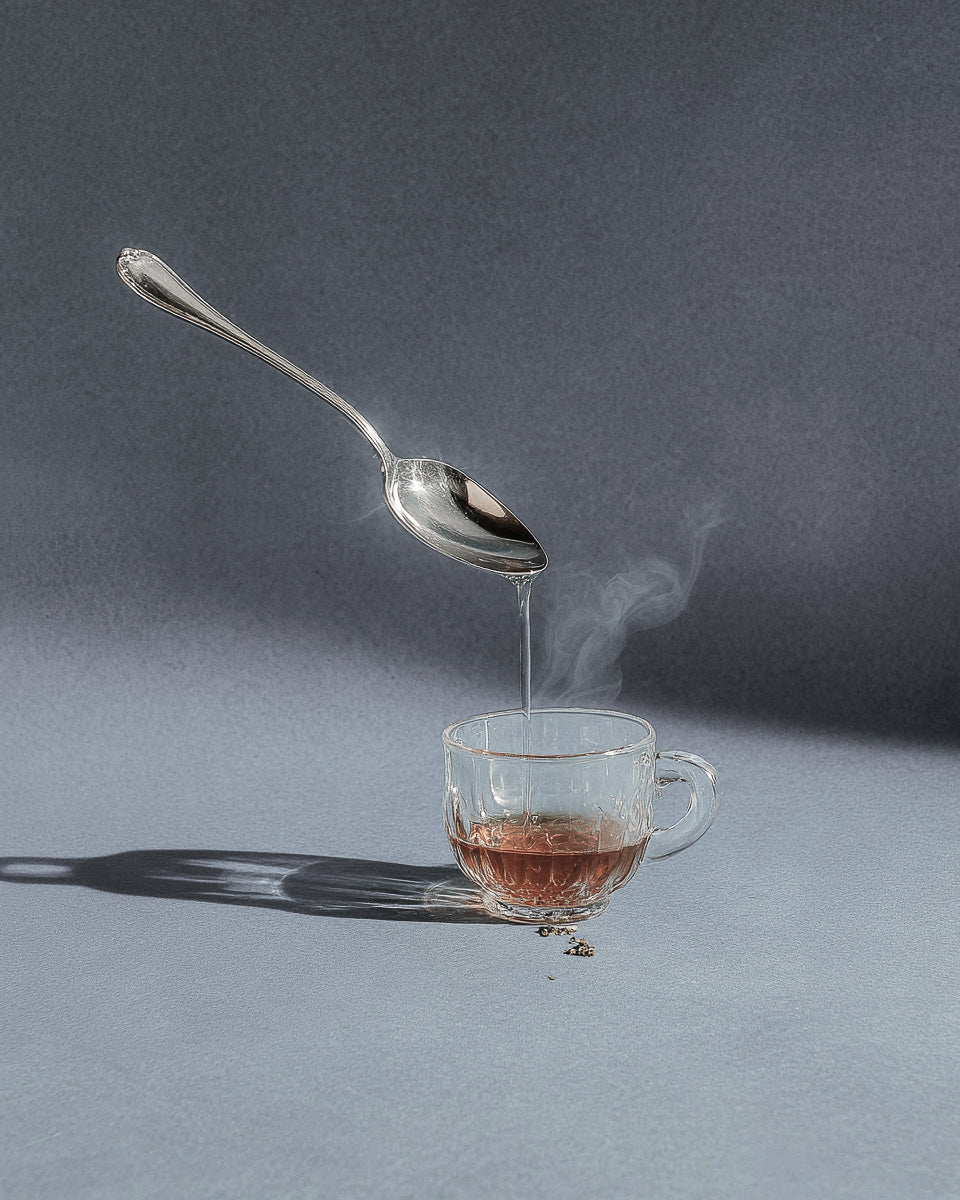
We drink tea because it creates a contained pause. Not a performance. Not a ceremony. Just a few minutes where heat, time, and material are doing something visible in front of you.
Measure the water.
Watch the leaf open.
Taste before it cools too much.
Nothing dramatic happens. But the rhythm shifts.
A well-blended tea opens cleanly, carries through the middle, and finishes without excess. When that structure holds, the experience feels settled rather than stimulating.
Tea doesn’t promise transformation.
It simply gives you something real to engage with — and that’s often enough.